
Careers & Hiring
Working in sales in defence tech
An overview of sales jobs in defence tech for people thinking of applying.
DefenceJobs.org·4d ago
In-depth reports on European defence companies, sectors, hiring and policy, drawn from our directory of the industry.
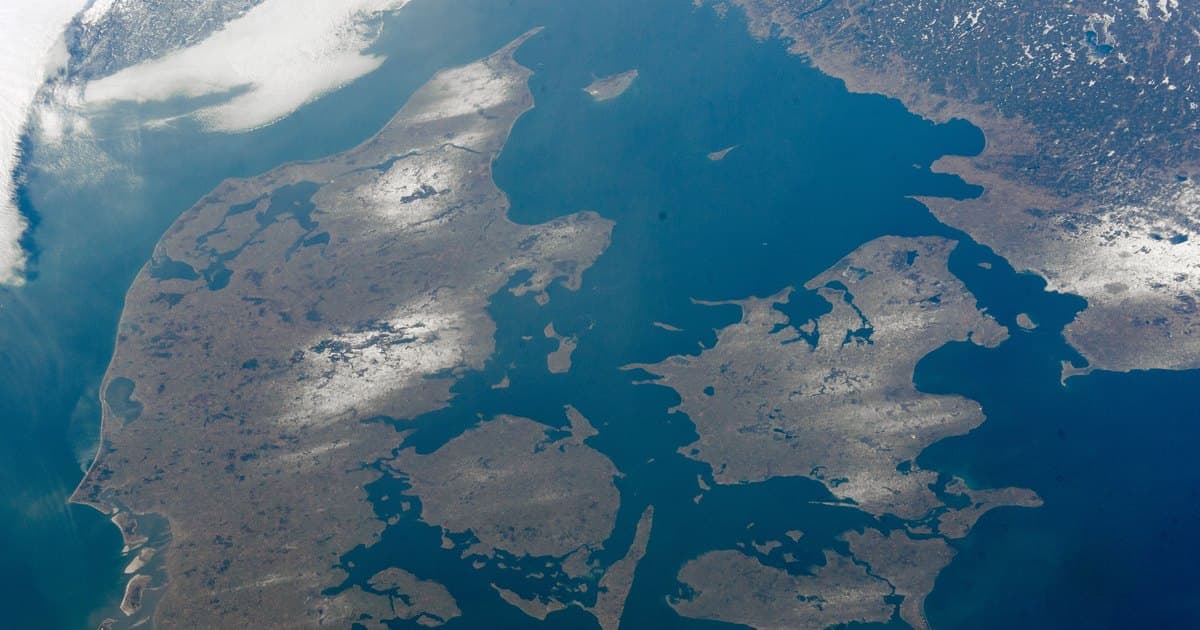
The state of Danish defence tech in 2026: the established companies, a younger layer of drone, sensor and space startups, where the money comes from, Ukrainian production in Denmark and where the jobs are.
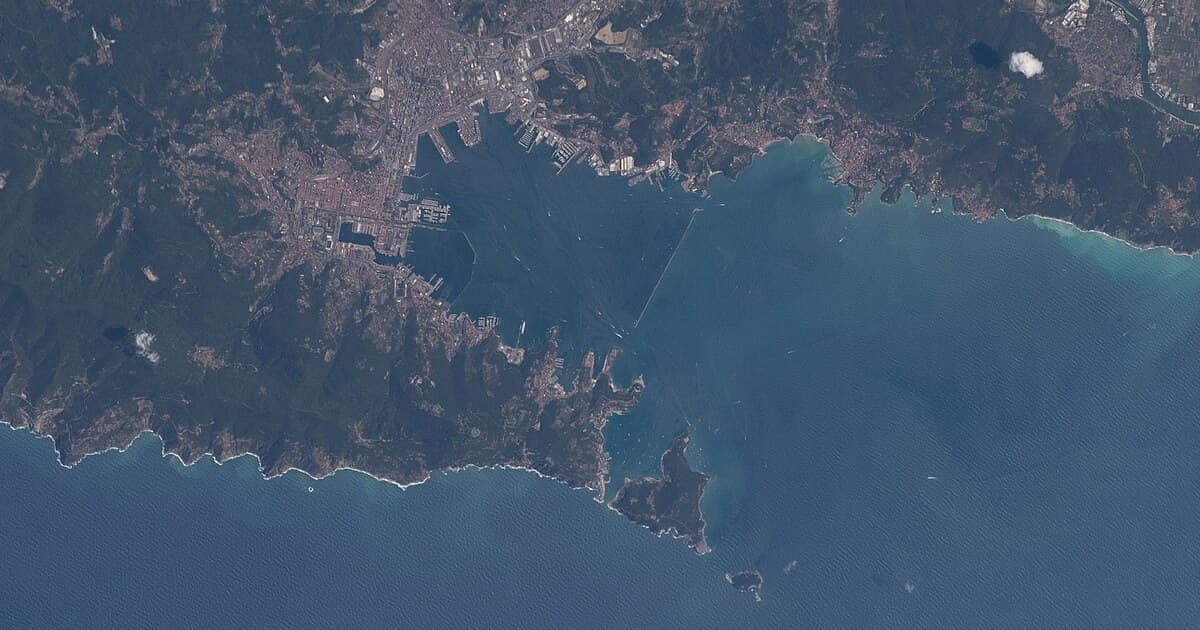
Most of Italy's defence companies are decades old, not startups. A report on 77 firms across naval, space, drones, sensors, cyber and quantum, with an interactive map and their open roles.

Helsing, Quantum-Systems, ARX Robotics and 90+ more German defence-tech companies, mapped sector by sector across Munich, Berlin, Bremen and Kiel.

What a country of 1.3 million builds for NATO. Ground robotics, drones, cyber, sensors and more. 40+ companies profiled across 8 sectors.
An overview of sales jobs in defence tech for people thinking of applying.

Many young people find defence careers attractive, but few plan to pursue one. What an EU study tells employers to change in their job ads and in hiring.
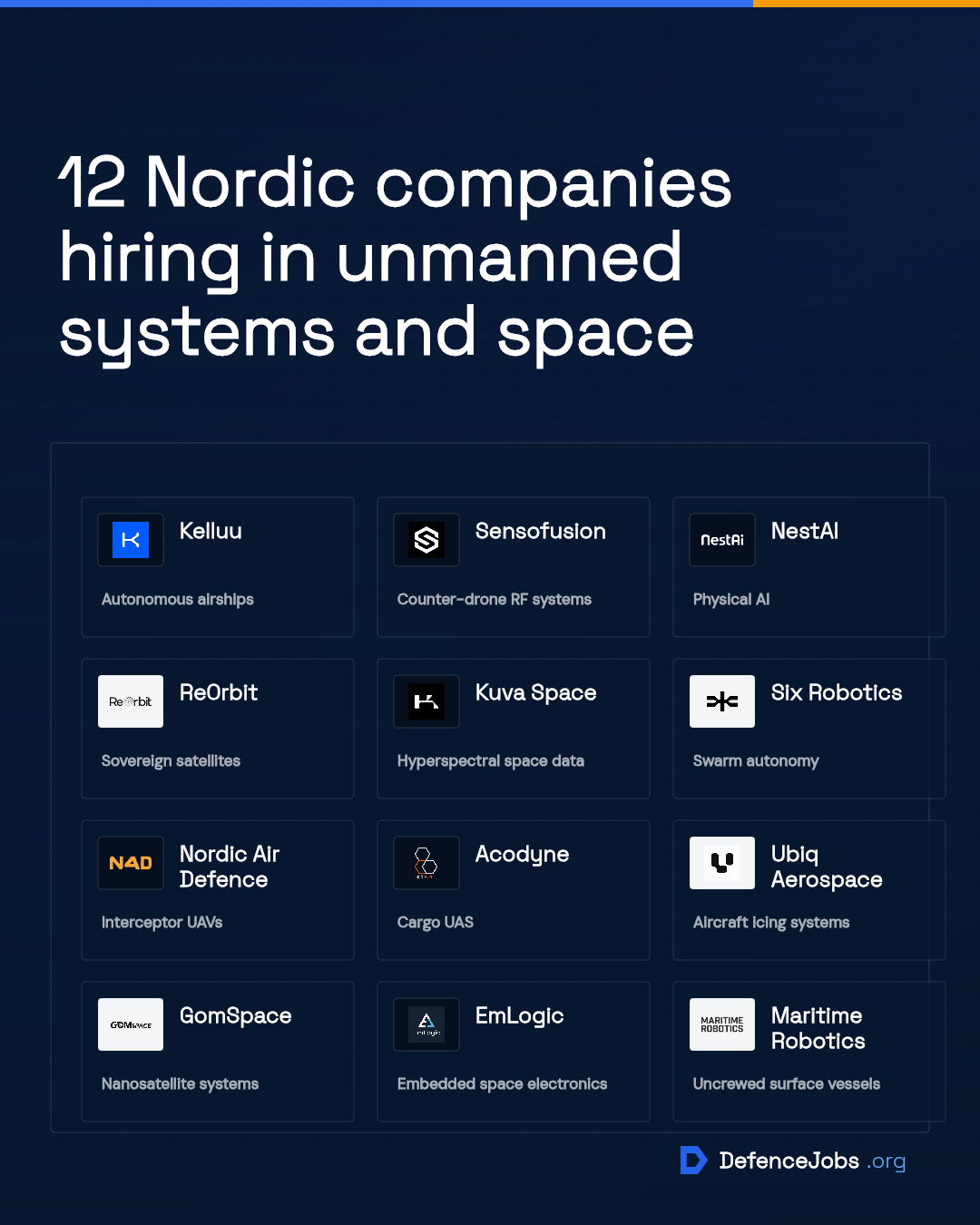
Nordic defence and dual-use companies listing roles across drones, satellites, autonomous airships, embedded electronics and uncrewed maritime systems.
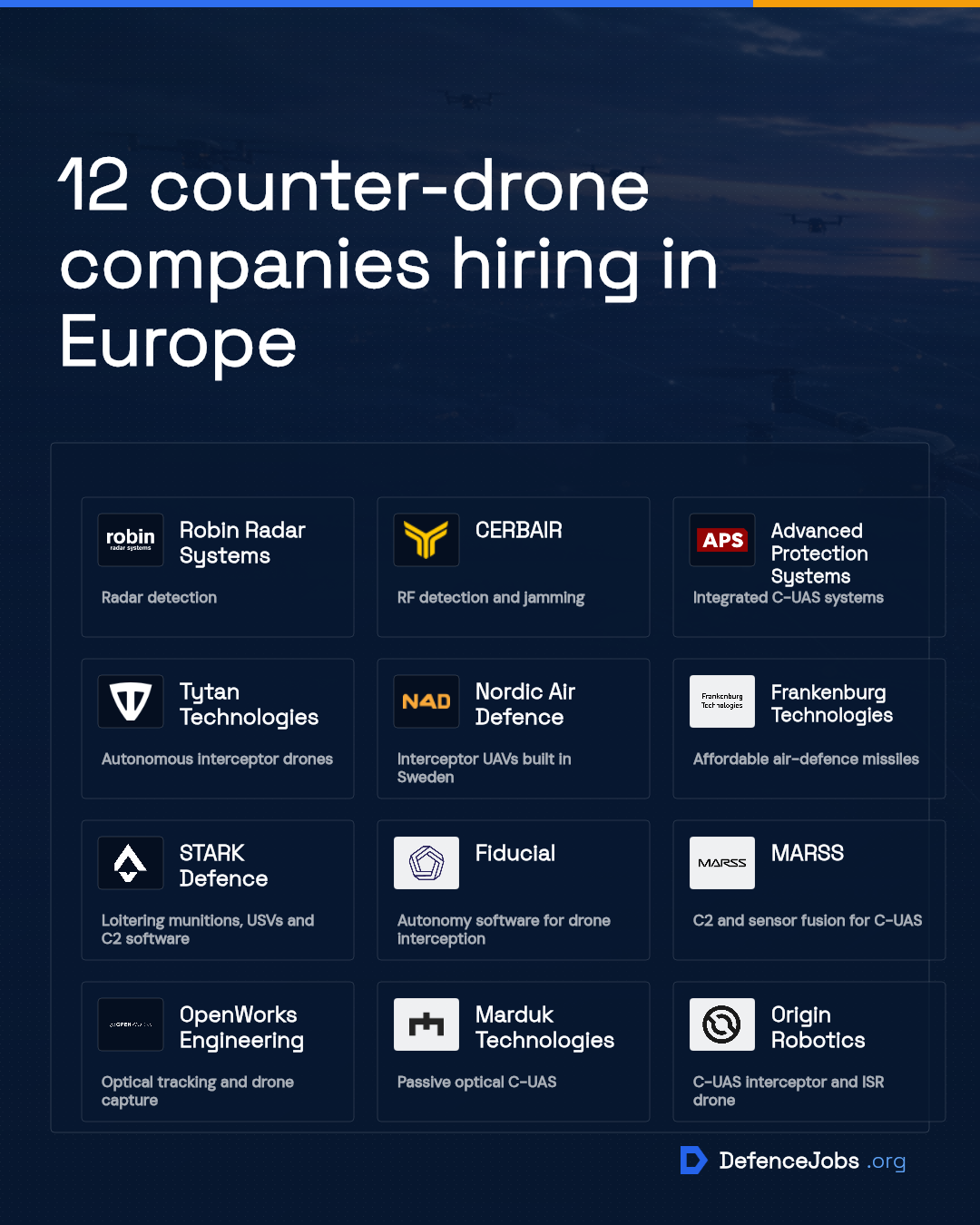
European companies building counter-drone products, with hiring locations and hiring areas checked in June 2026.
Czech drone companies went from near-zero to autonomous strike drones, swarm AI and mobile factories in three years. One was firebombed in March 2026.
A Budapest radar company supplies eight NATO armies. A Czech firm makes inflatable tanks that absorb real missiles. Six companies filling gaps nobody else can.
After Nord Stream and the Eagle S anchor drag, European startups are building the sensors, AUVs and comms Baltic Sentry needs to protect undersea cables.
A former Bundeswehr pilot built a mapping drone company. Ukraine turned it into a 3 billion euro defence giant with seven product lines and 146 open roles.
Belgium had no counter-drone systems. Now a new European industry is racing from prototypes to thousands of interceptors per month, and the field is wide open.
Where you build a defence tech career matters as much as what you build. Six European cities are pulling the industry into distinct, specialised clusters.
Ukraine proved unmanned ground vehicles work at scale. Now European companies are racing to build production lines and the software to connect them.
Europe needs 250,000 more defence engineers and a quarter of the workforce is near retirement. The market has never tilted this far toward candidates.
Europe's most valuable defence startup builds AI for fighter jets, strike drones and underwater gliders. A product-by-product breakdown of what Helsing makes.
Defence tech engineering means building systems that work when GPS is jammed, comms are down and someone smart is trying to make them fail.
From aerial surveillance to ground robotics and counter-drone, European autonomous systems companies are hiring across 10 countries. Where to apply now.
European defence tech companies are hiring fast. A practical guide to clearance, locations, the learning curve and how to land your first role in 2026.
Frankenburg and Tytan each raised €30M to build low-cost interceptors, betting Europe needs millions of cheap missiles, not dozens of expensive ones.
The EU's Security Action for Europe programme has approved €112B in defence investment plans for 16 member states, with first disbursements expected in Q1 2026. Poland leads with €43.7B.
Europe's defence industry faces a workforce gap of up to 500,000 workers by 2030. With 25% of engineers near retirement and 4:1 demand ratios, the talent crisis is the sector's biggest bottleneck.
European defence startups raised $8.7B in 2025, up 55% year-over-year. AI drove 44% of all funding. Munich led with $1.7B as late-stage investment tripled and 21 specialist defence funds reshaped the market.